

Quick Overview:听
For decades, PLM-CAD integration has been brittle, expensive, vendor-biased, and so unreliable that many engineering teams still re-enter CAD data into PLM manually. engineers waste up to 19% of their time on non-value-added data management tasks (searching for files, hunting for revisions, and rebuilding lost work), which slows new product development and breaks collaboration across the digital thread.
The fix is a modern, multi-CAD-aware, fault-tolerant approach: , a clearinghouse that standardizes part numbering, BOM sync, file governance, and release automation across a range of CAD and PDM environments, finally enabling seamless PLM-CAD integration at the speed and scale today's products demand.
Why PLM-CAD Integration Still Fails: Manual Data Entry and Multi-CAD Challenges
Despite three decades of attempts, engineering teams still react to the prospect of integrating their computer-aided design (CAD) and product lifecycle management (PLM) systems with a wince鈥攁nd for good reason. Many companies with multi-CAD environments face the same pattern:
Engineers design in CAD, then manually recreate items, part numbers, and BOMs in PLM, hoping nothing gets missed or mismatched. 鈫�
Release cycles accelerate from 1-2 per year to double or quadruple that to outpace competitors' innovation velocity, making manual re-entry completely untenable. 鈫�
Brittle integration "solutions" collapse as soon as formats drift or new CAD releases are adopted.
The underlying problem is structural: traditional PLM system vendors were built to optimize their own tool ecosystems, not the tool diversity that real manufacturers actually use.
Modern product development tech stacks blend:
- Multiple MCAD systems (e.g., SolidWorks, AutoCAD, Creo, NX, Inventor)
- ECAD systems (e.g., Altium, OrCAD)
- Growing software disciplines
- Increasingly distributed supply chains
- Multiple PDMs or none at all
A one-CAD, one-PDM worldview simply doesn't support today's complexity in the product development process.
How Much Time Do Engineers Waste on CAD Data Management?
Independent industry research reveals the scale of this challenge:
shows that engineers waste up to 19% of their time on non-value-added tasks searching for CAD files, addressing version control issues, and fixing problems caused by poor data management practices.
That's a day per week per worker lost to data chaos.
Multi-CAD environments create inefficiencies and redundancies where CAD data needs to be imported or manually rekeyed into a whole product view and available to the broader company.
Tech-Clarity also found that:
- Two-thirds of product companies say the consequence of these inefficiencies is missed deadlines and higher costs.
- Multi-CAD incompatibilities drive 79% of teams to experience delays that cascade into launch timelines.
- When design data is managed well, ~69% cite better collaboration, with faster, more timely access to the right revisions.
Manufacturers now compete on the speed of product releases, process agility, and their ability to collaborate across mechanical, electrical, and software domains. Without a dependable way to unify design data into the product record, innovation slows, releases slip, quality becomes reactive instead of intentional, and traceability suffers throughout the entire product lifecycle.
MORE RESOURCES: Watch the DesignHub webinar for an in-depth look at how DesignHub transforms design data collaboration, led by the expert insiders who created it.
Essential Requirements for Multi-CAD PLM Integration
A modern approach to PLM-CAD integration must support a company's actual CAD environment, not the environment a vendor wishes they had. That means delivering functionality across:
1. Multi-CAD Intake
Most manufacturing organizations operate with a mix of mechanical and electrical design tools, managed in various ways. Engineers contend with filing systems or PDM tools, often all on-premise, and adopting new versions of these tools ad hoc. All of these factors feed into the complex challenge of managing incompatible CAD data.
For PLM-CAD integration to be effective, design files, assemblies, changes, BOMs, AMLs, libraries, and sourcing intelligence all need clean pathways into the product record.
2. Standardized Integration Flows
Regardless of the tool, there is a core set of workflows and processes that provide the desired level of governance that companies are striving for:
- Centralized part numbering managed and provided by PLM
- Early version sharing so downstream stakeholders get visibility before release
- Pushing or publication of release candidates: parts, assembly structure, design artifacts, attributes, AMLs
- Governed release into PLM for approvals and enterprise visibility
3. Merge-Before-Commit Preview Checkpoint
Engineers should be able to preview deltas (add/update/delete) before data ever touches the product record, reducing the risk of errors and enabling better change management.
4. Automated BOM + Rendition Sync
Let the system automate the handling of structure, quantities, file generation, and metadata, every time. Ensure bill of materials accuracy and 3D model synchronization.
5. Fault Tolerance
Handle out-of-sync files, missing metadata, or messy folder structures without breaking, optimizing reliability across diverse CAD systems.
These requirements are the blueprint DesignHub is built on.
DesignHub: Where Multi-CAD Environments Meet Automated PLM Integration
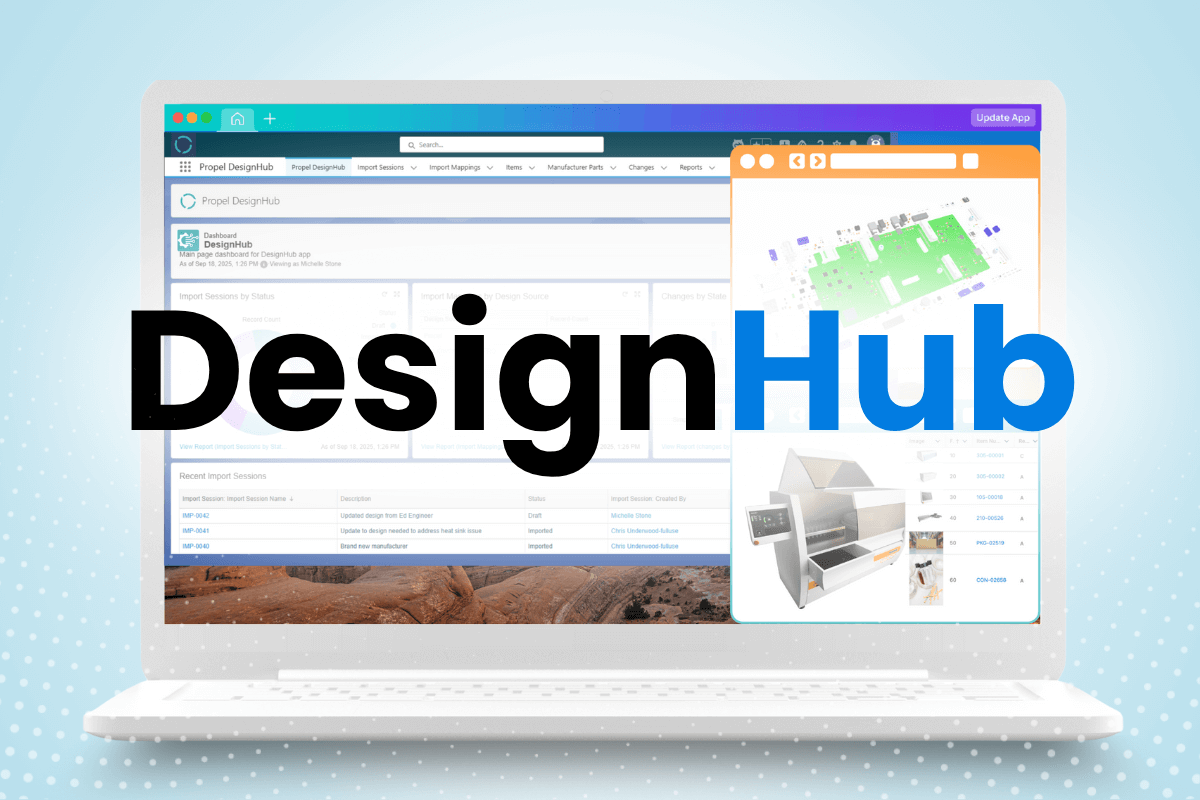
by Propel Software is a governed clearinghouse for multi-CAD design data. It centralizes how designs move from engineering into enterprise PLM, extending real-time collaboration so teams across sourcing, manufacturing, quality, and service can make faster, more informed decisions with complete product data.
Critical PLM integration processes are streamlined and transformed with DesignHub:
- Assigning part numbers without leaving CAD/PDM
- Syncing CAD files, BOMs, and AMLs into PLM
- Publishing design artifacts like IGES, STEP, and drawing files, and automating thumbnail creation
- Optionally automating the creation of interactive viewables for annotation and enterprise-wide interrogation
- Triggering review and release workflows in Propel PLM with proper change management
How DesignHub Works Across Three Environments
1. Teams with No PDM
Many engineering teams begin with shared folders, where CAD files get lost and version confusion is constant. Without structured version control, teams waste time tracking down the "right" file, or worse: redoing work based on outdated designs. DesignHub, with Bild鈥檚 multi-CAD fluent Cloud PDM option, brings instant control without heavy infrastructure.听
What DesignHub provides:
- Version tracking and controlled check-in/out (via integrated cloud PDM)
- Automatic part numbering pulled from PLM
- Auto-generated STEP, PDF, and thumbnails for product design documentation
- Full BOM extraction and synchronization with CAD data
- Release candidates pushed directly into governed PLM changes
Outcome:
A team with no PDM instantly gains disciplined configuration control and clean promotion into PLM鈥攏o servers, no IT stack, no lengthy setup. This l workflows and accelerates digital transformation.
2. Teams with On-Prem PDM
For companies with investments in on-prem PDM (e.g., SOLIDWORKS PDM Professional), DesignHub extends those systems; it doesn鈥檛 replace them. Using Razorleaf鈥檚 powerful CLOVER platform, DesignHub connects SOLIDWORKS files seamlessly into the whole product record.
What DesignHub provides:
- Automated release triggers tied to existing PDM workflows
- Migration of assemblies, parts, metadata, and file renditions into PLM
- Accurate, multi-level BOM mapping with full revision integrity
- The ability to push incremental files (STEP, IGES, PDFs) as needed for real-time data integration
- Bidirectional status updates that lock files during enterprise review
Outcome:
You keep your trusted PDM interface while eliminating manual re-entry, brittle scripts, and the risk of mismatched revisions. This approach validates product information integrity throughout the entire product lifecycle.
3. Teams with ECAD
demands accommodating different ECAD systems as part of electronics product development, yet lack of integration between CAD systems can hinder productivity and lead to data silos. DesignHub resolves that by standardizing ECAD integration, powered by Accelerated Designs.
What DesignHub provides:
- A unified cockpit for managing components and libraries across ECAD tools
- Automatic part numbering and metadata synchronization for product data management
- Zero-touch release of PCB BOMs, AMLs, and fab/manufacturing files
- Schematic PDFs and documentation auto-linked to the product record
- Supply-chain-aware component selection and lifecycle visibility
Outcome:
ECAD becomes a true partner to the PLM solution, enabling sourcing, compliance, manufacturing, and quality teams to get visibility from day one. 听
The Business Impact: Faster Releases, Reduced Rework, and Real-Time Collaboration
With DesignHub鈥檚 structured, predictable CAD-PLM flow:
Release cycles accelerate: companies move from slow batch drops to frequent, confident releases, reducing time-to-market.
探花精选 teams gain back time, reclaiming nearly a day per week per engineer previously lost to data management tasks, enabling focus on innovation and new product development.
Downstream stakeholders engage earlier, reducing late-stage surprises, rework, and costly design iterations.
Enterprise visibility improves, enabling smoother launches, better cost control, and faster decisions with real-time collaboration.
Multi-CAD no longer means data chaos. DesignHub harmonizes the entire product thread across the PLM environment, ensuring seamless data integration regardless of CAD software or PDM used.
demonstrates that PLM helps companies improve product innovation, product development, and engineering efficiency while enhancing communication across the enterprise and supply chain.听
This is the first approach to seamless PLM-CAD integration built for the complexity of modern manufacturing, not the constraints of 1990s technology.
The Future of PLM-CAD Integration Starts Here
For decades, teams have settled for fragile point-to-point integrations or manual re-entry. finally delivers an approach built for reality: multi-CAD, multi-discipline, fast-moving, global manufacturing with seamless PLM integration.
If your engineering teams are still burning hours reconciling versions or copying data between systems, this is the moment to change course and embrace digital transformation.
DesignHub is where design comes together, and where the product record finally becomes whole.听
FAQs
Does DesignHub force engineers to change tools?
No. It works with cloud PDM, on-prem PDM, MCAD, and ECAD tools. You keep your current environment and streamline workflows without disruption.
Can we preview the impact before committing to PLM?
Yes. DesignHub shows all BOM and item deltas before anything updates the product record, allowing engineers to validate changes.
Do we need the same CAD system across teams?
No. DesignHub is intentionally multi-CAD: MCAD, ECAD, mixed stacks, and hybrid environments with CAD integration across platforms.
How does DesignHub handle BOMs?
Fully automated extraction, structure mapping, quantities, metadata, and viewables into PLM, ensuring bill of materials accuracy.
Is ECAD truly integrated?
Yes. Parts, BOMs, AMLs, schematics, and manufacturing files are all unified into the PLM record with complete traceability.
Can DesignHub scale across multiple releases per year?
That's exactly what it's designed for: high-frequency, multi-discipline product development with real-time data integration.
Centralize design data no matter your CAD setup.


